|
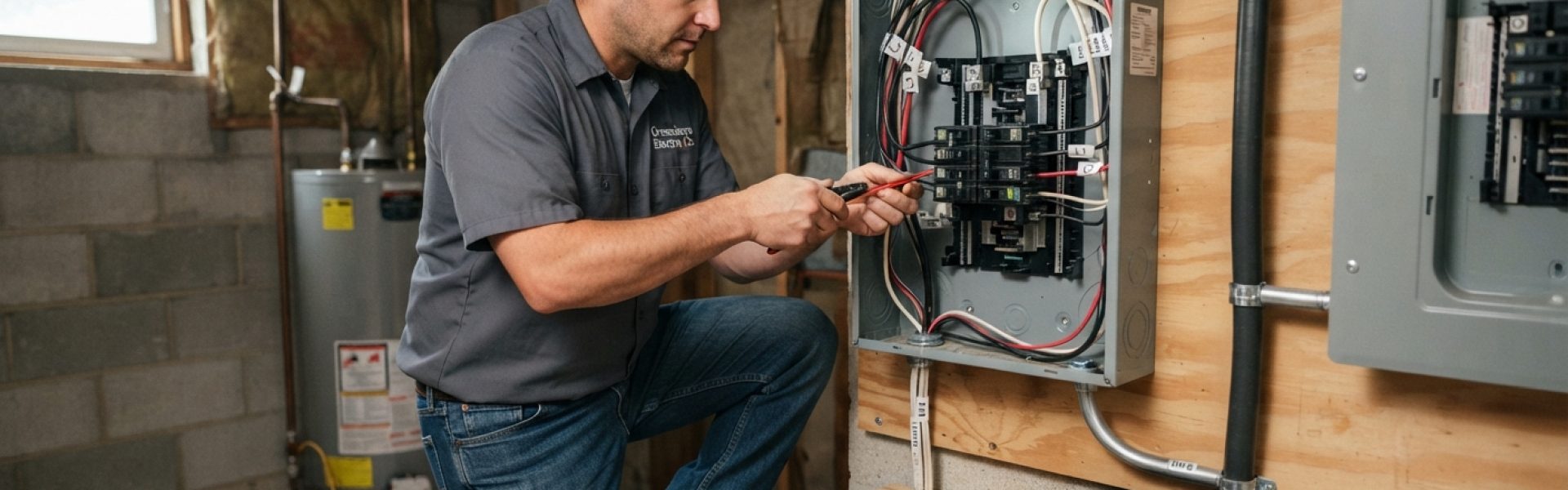
A subpanel adds breaker space by distributing power from your main panel, while a main panel upgrade increases the total electrical capacity of a Greensboro home, typically to 200 amps. A subpanel is appropriate when the service has spare capacity but no open slots. An upgrade is required when the home needs more power. Our licensed, bonded, and insured team provides both through our panel upgrade service. Schedule a load assessment. |
Homeowners often consider a subpanel when the main panel is full and new circuits are needed for a garage, a finished basement, or an EV charger. In some homes a subpanel is the right solution. In others, the main panel must be upgraded first. Our electrical panel upgrade team determines which approach fits by evaluating the capacity of the existing service.
This article explains how each option works, when each is appropriate, and what a code compliant installation requires. It is intended to help homeowners make an informed decision alongside the broader information in our complete guide to home electrical services.
What Is a Subpanel?
A subpanel is a secondary breaker panel supplied by a single large breaker in the main panel. It receives power from the main panel and distributes it to a specific area of the home or property. Subpanels are a regular part of our electrical installation services and are commonly located in:
- Detached garages and workshops
- Finished basements and bonus rooms
- Home additions and guest suites
- Pool houses, sheds, and outdoor kitchens
- Larger garages equipped with an EV charger
A subpanel does not create additional power. It organizes and distributes the power already supplied by the main service, which is why planning for an EV charger installation often begins with a review of available capacity.
What Is a Main Panel Upgrade?
A main panel upgrade replaces the primary breaker panel with a larger unit, usually together with a service upgrade that raises the total amperage of the home. The most common upgrade is from 100 amps to 200 amps, and our guide to 100 amp vs 200 amp panels explains why 200 amps has become the residential standard.
An upgrade may include a new panel, meter base, service entrance conductors, updated grounding, and coordination with Duke Energy. It is a larger project than a subpanel installation, but it resolves capacity and safety issues that a subpanel cannot, and each one follows our established service and panel upgrade process.
Can a Subpanel Increase a Home’s Amperage?
No. A subpanel provides additional breaker slots, not additional power. A home with 100 amp service will still have 100 amps available after a subpanel is installed. Our article on the signs your electrical panel needs an upgrade describes how an overloaded system typically presents itself.
For this reason, a load calculation is always the first step. Adding a subpanel and new circuits to a service that is already near its limit can lead to tripped breakers, overheating, and conditions that require our emergency electricians.
Subpanel vs. Main Panel Upgrade Compared
The table below outlines the primary differences between the two options. Additional detail on panel projects is available on our service and panel upgrade page.
|
Factor |
Subpanel |
Main Panel Upgrade |
|---|---|---|
|
Adds breaker space |
Yes |
Yes |
|
Increases total amperage |
No |
Yes, when paired with a service upgrade |
|
Typical cost |
Lower |
Higher |
|
Duke Energy coordination |
Not usually |
Usually required |
|
Resolves an unsafe main panel |
No |
Yes |
|
Best fit |
Garages, basements, additions with spare capacity |
Older homes, EV chargers, generators, all electric homes |
When a Subpanel Is the Right Choice
A subpanel is often the more efficient and affordable option when the main service is in good condition. Our team typically recommends one during electrical installation projects when the following conditions apply:
- The home already has 200 amp service with available capacity
- The main panel is in good condition but has no open slots
- Several new circuits are needed in one area far from the main panel
- A detached garage, workshop, or outbuilding requires power
- A convenient local shutoff is desired for a basement or addition
Subpanels also simplify long circuit runs. A single feeder supplies the subpanel, and shorter branch circuits serve the area from there. The result is a cleaner, more organized installation, completed and labeled by our electrical panel wiring services team.
Can a Subpanel Be Added to a 100 Amp Service?
In some cases. A 100 amp service can supply a subpanel when the load calculation confirms sufficient unused capacity. This is often feasible for a small workshop, a few lighting and receptacle circuits, or a basement heated by gas, and our residential service call team can complete that evaluation.
It is rarely feasible for large loads such as a Level 2 EV charger, an electric heat pump, a hot tub, or a welder. In those situations, upgrading to 200 amps before adding the subpanel is the safer and more cost effective approach, as explained in our article on panel upgrades before a Level 2 EV charger.
When a Main Panel Upgrade Is the Better Choice
An upgrade is appropriate when the limitation is capacity or safety rather than space. Many homes in Westerwood and College Hill fall into this category, particularly when one or more of the following apply:
- The home has 60 amp or 100 amp service
- The load calculation shows little or no remaining capacity
- Breakers trip regularly under normal use
- The home has a fuse box, a Federal Pacific Stab Lok panel, a Zinsco panel, or visible corrosion
- An EV charger, standby generator, heat pump, or electric appliances are planned
- A full rewire or major remodel is underway
Our article on 7 signs your home needs a panel upgrade provides further guidance. Homeowners planning for backup power should also review whether their panel needs an upgrade for a standby generator.
How Electricians Decide: The Load Calculation
A load calculation is a code based assessment of the home’s actual electrical demand. It is the most important factor in choosing between a subpanel and an upgrade, and it is part of every panel assessment we perform. The calculation considers:
- Square footage of the home
- Heating and cooling equipment
- Water heater, range, dryer, and other fixed appliances
- Existing and planned circuits, including EV charging
- Future additions such as a generator, hot tub, or home addition
When the results show adequate capacity, a subpanel is usually the efficient choice. When they do not, the main service must be upgraded first. In many homes, the best long term solution combines both: a 200 amp upgrade followed by a subpanel where it is most useful. A whole house surge protector is a worthwhile addition to either project.
Requirements for a Code Compliant Subpanel
Subpanel installations must meet specific requirements of the National Electrical Code and the North Carolina Electrical Code. Our panel wiring crew addresses each of the following:
- Correct feeder and breaker sizing to safely carry the planned load
- Separate neutral and ground bars, since bonding them together is a common cause of failed inspections
- A four wire feeder consisting of two ungrounded conductors, a neutral, and an equipment ground
- Dedicated grounding electrodes when the subpanel is located in a detached garage or outbuilding
- Required working clearance of typically 30 inches wide and 36 inches deep, with no installation in closets or bathrooms
- A permit and inspection through the City of Greensboro
Subpanels for EV Chargers and Detached Garages
EV charging is one of the most common reasons Greensboro homeowners request a subpanel. A Level 2 charger generally requires a dedicated 40 to 50 amp breaker, and Tesla Wall Connectors often use a 60 amp circuit for maximum charging speed. When the garage is located away from the main panel, a subpanel can be the most practical way to deliver power, and our EV charger installation team plans each project accordingly.
On a 100 amp service, however, a subpanel does not resolve a capacity shortfall. For guidance on charger selection, our comparison of hardwired vs. plug in EV chargers outlines the advantages of each type.
Cost Considerations in Greensboro
A subpanel generally costs less than a main panel upgrade because it does not involve the meter base, service conductors, or utility coordination. Final pricing depends on subpanel size, distance from the main panel, trenching for detached buildings, and permit fees. You can request a quote and receive clear, affordable pricing before work begins.
The most costly outcome is installing a subpanel when the home actually required an upgrade, then completing the upgrade later. A thorough assessment by our service call team prevents that situation.
Why Choose Triad Electric Solutions?
Triad Electric Solutions is a locally owned electrical contractor founded in 2021, with more than 500 completed projects across Greensboro and the Triad. Additional information is available on our about us page.
- Licensed, bonded, and insured in North Carolina
- Top rated reviews, including 4.8 stars on Google and 5.0 stars on Facebook, Yelp, and Thumbtack
- A six month labor and workmanship guarantee on all work
- Permitted, inspected, code compliant installations
- 24/7 emergency response
We also support property managers and business owners through our commercial electrician services.
Subpanel Installation in Greensboro, NC
Triad Electric Solutions provides subpanel installations and panel upgrades throughout Greensboro, including Irving Park and Hunter Hills, as well as High Point and Kernersville.
A complete list of neighborhoods is available on our service areas page. To schedule a load assessment, call 336.499.2015 or contact our office.