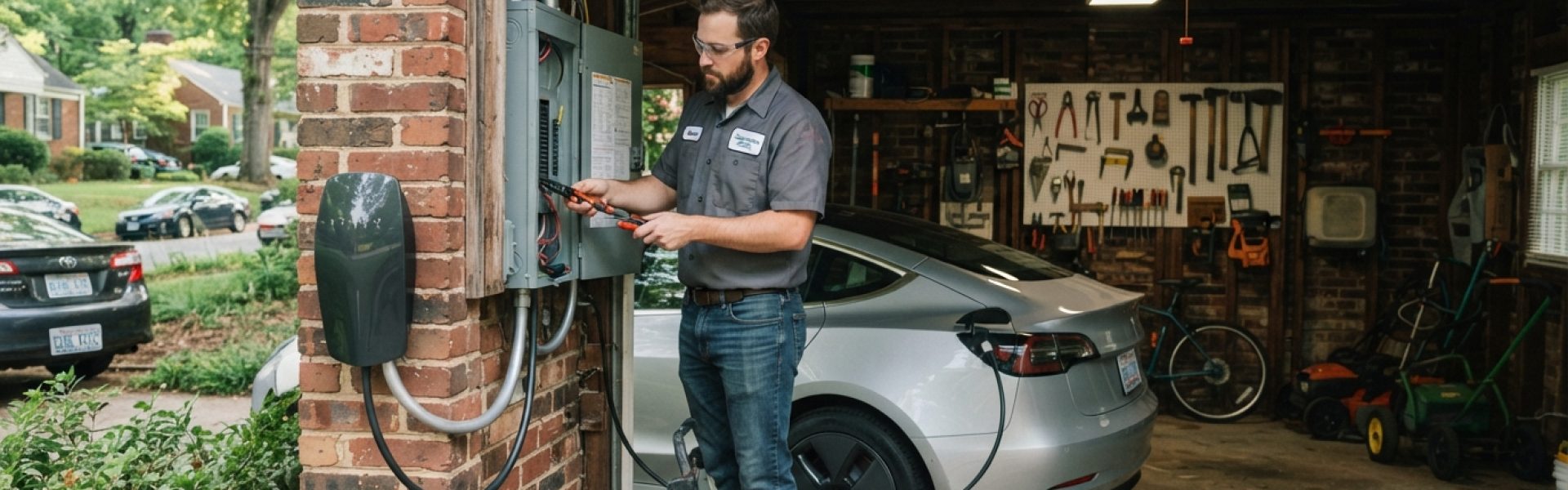
A Level 2 EV charger can be installed in a detached garage in Greensboro, NC. Most projects require an underground feeder from the main panel, a garage subpanel with its own grounding system, and a permitted installation that meets the National Electrical Code. Distance, trenching, and panel capacity are the main cost factors. Our licensed, bonded, and insured EV charger installation team manages every step. Schedule a site assessment. |
Detached garages are common throughout Greensboro’s established neighborhoods, including Fisher Park and Westerwood. They provide excellent protection for a vehicle, but they make charger installation more involved than in an attached garage.
A detached garage is a separate structure, often located 30 to 100 feet or more from the main panel, and it may be served only by a small circuit for lighting and a door opener. The considerations below are the same factors our EV charger installation team evaluates before installing a Level 2 charger in a detached building.
Can an EV Charger Be Installed in a Detached Garage?
Yes. With proper planning, a detached garage is a practical location for a Level 2 charger. The project involves more components than a typical electrical installation, generally including:
- A load calculation to confirm available capacity at the main panel
- An underground or overhead feeder from the home to the garage
- A subpanel in the garage with proper grounding
- A dedicated 240 volt circuit for the charger
- Permits and inspections through the City of Greensboro
Attached vs. Detached Garage Installations
In an attached garage, the charger circuit can usually run directly from the main panel through a wall or attic space. These installations are relatively simple and are routinely completed by our residential service call team.
A detached garage introduces additional requirements. Power must travel underground or overhead between two structures, a subpanel with its own grounding is typically required, conductors are larger to account for distance, and trenching or hardscape restoration adds time. Understanding these factors in advance supports accurate budgeting, and our EV charger installation page outlines what each project includes.
Does the Detached Garage Have Sufficient Power?
In most cases, no. Detached garages are usually supplied by a single 15 or 20 amp, 120 volt circuit for lighting and a door opener. That circuit can support Level 1 charging at a few miles of range per hour, but not a Level 2 charger, as explained in our guide on panel upgrades before a Level 2 EV charger.
A Level 2 charger requires a dedicated 240 volt circuit, typically on a 40 to 50 amp breaker. Tesla Wall Connectors often use a 60 amp circuit to add up to 44 miles of range per hour. The existing garage wiring is usually replaced with a larger feeder, which our electrical panel wiring services team installs.
1. Main Panel Capacity
The main panel must have capacity for the new load before any trenching begins. Many older Greensboro homes with 60 or 100 amp service require a service and panel upgrade to 200 amps before a detached garage charger can be added safely.
Our 100 amp vs 200 amp panel guide explains the difference in capacity, and our article on 7 signs your home needs a panel upgrade lists common indicators of an undersized service.
2. Feeder Size and the Garage Subpanel
For a detached garage, the most effective solution is usually a feeder to a subpanel inside the garage. The subpanel then supplies the charger along with lighting, receptacles, and future circuits. This is a standard component of our electrical installation services, and the two most common feeder sizes are:
- 60 amp feeder: suitable for one Level 2 charger and basic lighting
- 100 amp feeder: suitable for one or two chargers, a workshop, an air compressor, or a ductless mini split
When a second EV, power tools, or a heater may be added in the future, a larger feeder installed now is far more economical than trenching a second time. Completing a service and panel upgrade at the same time can make the larger feeder possible.
3. Distance and Voltage Drop
Greater distance between the garage and the main panel may require larger conductors. Long runs produce voltage drop, which can reduce charging speed and place additional strain on the charger. Conductors are sized according to the actual distance and load, consistent with the standards applied to every panel wiring project we complete.
4. Trenching and Burial Depth
Most detached garage feeders are installed underground. The National Electrical Code establishes minimum burial depths based on the wiring method, and our electrical installation crew follows them on every project:
- PVC conduit: at least 18 inches for typical residential feeders
- Direct burial cable: at least 24 inches
- Beneath driveways: at least 24 inches, regardless of method
- Rigid metal conduit: as shallow as 6 inches in certain locations
Before excavation, NC 811 must be contacted to mark underground utilities such as gas, water, and communication lines. Greensboro’s red clay soil, tree roots, patios, and concrete driveways can all affect the duration and cost of trenching, and the route is reviewed during the site assessment.
Overhead vs. Underground Feeder
Underground feeders are the most common choice because they are protected, concealed, and unaffected by storms. Overhead feeders may cost less to install, but they require specific clearances above driveways and are vulnerable to falling limbs, a significant concern on mature, wooded lots in Irving Park and Sunset Hills. Underground conduit is generally recommended because it also simplifies future upgrades.
5. Grounding and Neutral Separation
A subpanel in a detached structure is subject to specific grounding requirements under the National Electrical Code. Correct grounding is a central part of our electrical panel wiring services:
- A four wire feeder with two ungrounded conductors, a neutral, and an equipment ground
- A separate grounding electrode system at the garage, typically ground rods
- Neutral and ground conductors kept on separate bars within the subpanel
Combining neutral and ground in a detached garage subpanel is one of the most frequent causes of failed inspections. Mild shocks or flickering lights in an outbuilding can indicate this type of problem, as described in our article on common wiring issues.
6. Hardwired or Plug In Charger
A Level 2 charger can be hardwired or connected to a 240 volt receptacle. In a detached garage, a hardwired unit is often preferred because it supports charging up to 48 amps on a 60 amp circuit, avoids receptacle wear from daily use, and provides a cleaner installation. Our comparison of hardwired vs. plug in EV chargers reviews both options in detail.
We install universal chargers compatible with Tesla, Chevy, Ford, Hyundai, Kia, BMW, Audi, Nissan, Toyota, and Volkswagen vehicles. Households expecting a second EV should account for it during planning, and our EV charger installation team can size the feeder accordingly.
7. WiFi Coverage, Weather, and Mounting Location
Smart chargers rely on WiFi for scheduling, energy monitoring, and software updates. Detached garages are often beyond the range of the home router, so a mesh node or extender may be needed. This is reviewed during every home charging assessment.
Chargers mounted on an exterior wall should be rated for outdoor use and protected by a whole house surge protector. Cable reach should accommodate the vehicle whether it is parked facing forward or backed in.
8. Permits and Inspections in Greensboro
A detached garage charger installation requires an electrical permit and inspection through City of Greensboro Engineering and Inspections. We manage all required permits so that each installation meets the NEC, the North Carolina Electrical Code, and local safety standards, as outlined in our complete guide to home electrical services.
Cost of a Detached Garage EV Charger
A standard Level 2 installation in an attached garage typically costs $300 to $800 in labor and materials, excluding panel upgrades. A detached garage costs more because of the feeder, trenching, and subpanel. Distance, feeder size, trenching surface, grounding requirements, and any service and panel upgrade all influence the final price.
We provide clear, affordable pricing following a site visit so that every cost is known in advance. Quotes can be requested online at any time.
Our Detached Garage EV Charger Installation Process
Each project is managed from the initial walkthrough through final testing, consistent with every EV charger installation we complete:
- Home charging assessment. We evaluate the panel, garage, distance, and driving needs.
- Project plan. We recommend the feeder size, subpanel, and charger.
- Permits and approvals. We file permits and arrange utility marking.
- Installation. We trench, install the feeder and subpanel, and mount the charger.
- Testing. We test the system and confirm proper charging.
- Ongoing support. We remain available for questions, upgrades, or a second charger.
Additional Upgrades to Consider
A new feeder to the garage is an ideal opportunity to complete related improvements. Workshop circuits and upgraded lighting fit within our electrical installation services, and older properties may benefit from a whole home rewire or remodel.
Some homeowners also add backup power to keep the vehicle charged during outages. Before selecting a generator, review whether your panel needs an upgrade for a standby generator and explore our generator installation services.
Why Choose Triad Electric Solutions?
Triad Electric Solutions is a locally owned Greensboro electrical contractor and a member of the Qmerit Network of EV charger installers. Additional information is available on our about us page.
- Licensed, bonded, and insured in North Carolina
- More than 500 projects completed since 2021
- Top rated reviews, including 4.8 stars on Google and 5.0 stars on Facebook, Yelp, and Thumbtack
- A six month labor and workmanship guarantee on all work
- 24/7 emergency response
For other electrical needs, our service calls and repairs team and our emergency electrical repair crew are available to assist.
Detached Garage EV Charger Installation in Greensboro, NC
Triad Electric Solutions installs EV chargers in detached garages throughout Greensboro, including Old Irving Park and Starmount, as well as High Point and Kernersville.
A complete list of neighborhoods is available on our service areas page. To schedule a site assessment, call 336.499.2015 or contact our office.