|
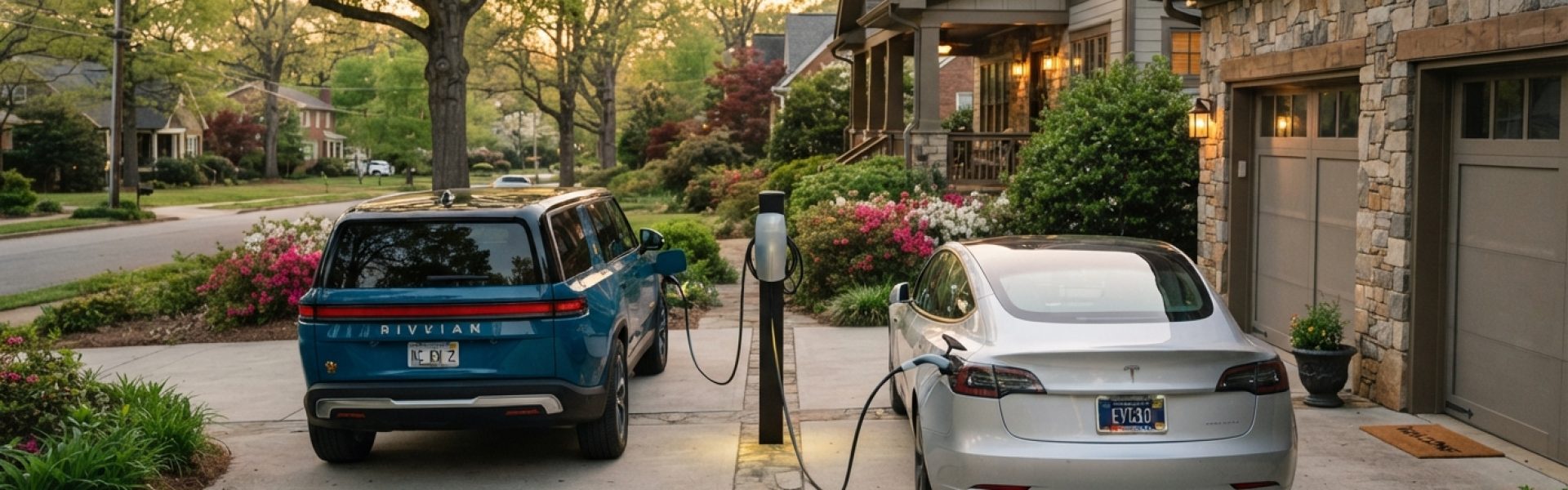
Two electric cars can be charged at home in Greensboro, NC with the right setup. Most households use either two Level 2 chargers on separate circuits or a power sharing system that divides one circuit between both vehicles. The best option depends on panel capacity and daily mileage. Our licensed, bonded, and insured EV charger installation team manages load calculations, permits, and panel upgrades. Schedule a home charging assessment. |
Households with two electric vehicles are increasingly common in Greensboro. A typical arrangement involves one vehicle used for a daily commute and another for errands or regional travel, with both needing a full charge each morning. Home charging for two vehicles is entirely achievable, and our EV charger installation team designs these systems regularly.
The right configuration depends on the electrical panel, driving patterns, and budget. This article covers the power requirements of two EVs, the most practical charging configurations, and the situations in which a panel upgrade becomes necessary.
Can a Home Electrical System Support Two EV Chargers?
In most cases, yes. A home with 200 amp service can often support two Level 2 chargers, particularly with load management. A home with 100 amp service typically requires either a power sharing configuration or a service and panel upgrade before a second charger is added.
A load calculation provides the definitive answer. It accounts for HVAC equipment, the water heater, dryer, range, and other major loads to determine how much capacity remains for charging. Our guide on panel upgrades before a Level 2 EV charger explains this evaluation in more detail.
How Much Power Do Two Electric Cars Require?
A Level 2 charger operates on 240 volts and adds approximately 25 to 30 miles of range per hour, four to six times faster than a standard household outlet. Most EVs can be fully charged overnight at this rate. Our comparison of hardwired vs. plug in EV chargers explains how charger type affects performance. Common circuit sizes include:
- 40 amp circuit: approximately 32 amps of continuous charging
- 50 amp circuit: approximately 40 amps of charging, the most common residential configuration
- 60 amp circuit: up to 48 amps, frequently used for Tesla Wall Connectors and capable of adding up to 44 miles of range per hour
EV charging is classified as a continuous load, so each circuit must be rated at 125 percent of the charger’s output. Two chargers operating at full output simultaneously can draw 80 to 96 amps, which makes capacity planning essential. Our 100 amp vs 200 amp panel guide places those figures in context.
Do Both Chargers Need to Run at Full Output?
Rarely. Most Greensboro drivers travel far fewer miles per day than a Level 2 charger can replace overnight. When each vehicle needs 30 to 50 miles of range per day, a shared circuit can typically recharge both vehicles before morning, a point we review during every home charging assessment.
For this reason, many two EV households choose power sharing rather than two full capacity circuits. Both vehicles are charged by morning without the cost of capacity that would seldom be used, and in many homes this approach avoids the need for a service upgrade.
Five Ways to Charge Two Electric Cars at Home
There is no single configuration that suits every home. The following five options are the setups most frequently installed through our EV charging service.
1. Two Level 2 Chargers on Separate Circuits
Each vehicle has a dedicated 240 volt circuit and charger. This configuration delivers the fastest charging and suits high mileage drivers in homes with 200 amp service and ample spare capacity. Because it requires the most amperage, we confirm availability through a panel assessment before installation.
2. Power Sharing Smart Chargers
Two compatible smart chargers share a single circuit and communicate with each other. When both vehicles are connected, the available power is divided between them, and when one vehicle finishes, the other receives the full output. Tesla Wall Connectors and several other Level 2 chargers support this feature, typically requiring matching brands. It is the configuration we most often recommend to Greensboro EV owners.
3. Dual Port Level 2 Charger
A dual port charger is a single unit with two cables designed to charge two vehicles from one circuit. It offers a clean installation where both vehicles park side by side in the same garage. Total output is divided between the two cables, and our electrical installation crew positions the unit so that both cables reach comfortably.
4. Energy Management Systems
An EV energy management system monitors total household electrical demand in real time and reduces charging speed when other appliances are in use. The National Electrical Code permits these systems to be considered in EV circuit sizing, which can defer or eliminate a costly panel upgrade. The tradeoff is reduced charging speed during periods of high household demand.
5. One Level 2 Charger With a Standard Outlet
When one vehicle is driven infrequently, a dedicated 120 volt outlet may meet its needs. Level 1 charging adds only a few miles of range per hour, so this option suits a secondary vehicle paired with a daily commuter. A dedicated outlet can be added during any residential service call.
Is a 200 Amp Panel Sufficient for Two EV Chargers?
Frequently, yes. A 200 amp service is the standard for modern homes, and many can support two chargers with power sharing or load management. Homes with electric heat, an electric range, a pool, or a hot tub require a closer review, as explained in our 100 amp vs 200 amp panel guide. A home with 100 amp service will most likely require one of the following:
- A power sharing or load managed charging configuration
- A 100 amp to 200 amp service upgrade
- A garage subpanel, where capacity allows
Older homes in Lindley Park and Sunset Hills are more likely to require an upgrade first. Our article on 7 signs your home needs a panel upgrade describes the common indicators.
Warning Signs of an Overloaded Panel
Operating two chargers at full output on a panel without sufficient capacity creates a safety risk. If any of the following occur, charging should be stopped and our emergency electricians contacted immediately:
- The main breaker or EV breakers trip during charging
- Lights dim when the chargers begin operating
- Breakers or the panel cover feel warm to the touch
- A burning odor is present near the panel
- Chargers stop or slow without explanation
Our electrical repair services can identify the cause and correct overloaded circuits so that charging can resume safely.
Charging Two Different EV Brands in One Garage
Many households own vehicles from different manufacturers, such as a Tesla alongside a Ford, Chevrolet, Hyundai, or Kia. Our universal installations support Tesla, Chevy, Ford, Hyundai, Kia, BMW, Audi, Nissan, Toyota, and Volkswagen vehicles, as detailed on our EV charger installation page.
Most automakers are adopting the NACS connector originally developed by Tesla, and adapters allow J1772 and NACS vehicles to share compatible chargers. We recommend equipment that serves both current vehicles and future purchases, and our hardwired vs. plug in comparison can assist with that decision.
Best Practices for Two EV Households
A few practical measures improve efficiency and protect equipment. A whole house surge protector is one of the most effective ways to safeguard two chargers and the vehicles connected to them. Additional recommendations include:
- Schedule overnight charging through the vehicle or charger app to avoid evening peak demand.
- Review Duke Energy rate options, as a time of use plan may reduce overnight charging costs.
- Plan parking and cable reach so both vehicles can connect without cables crossing walkways.
- Size the panel for future loads if a generator or heat pump is planned.
Homeowners planning backup power should also review whether their panel needs an upgrade for a standby generator. Most generators are configured to support essential circuits, with EV charging reserved for when it is needed.
Cost of a Two EV Charging Setup
A standard Level 2 charger installation typically costs $300 to $800 in labor and materials, excluding panel upgrades. A two vehicle configuration costs more depending on the number of circuits, the distance from the panel, indoor or outdoor mounting, and whether a subpanel or service upgrade is required. You can request a quote and receive clear, affordable pricing before work begins.
Our Two EV Charger Installation Process
Every EV charger installation follows a structured process, with permitting and testing managed by our team:
- Home charging assessment. We review the panel, wiring, parking layout, and driving patterns.
- Recommendation. We propose the configuration best suited to the vehicles and budget.
- Permits and approvals. We obtain all permits to meet the NEC and the North Carolina Electrical Code.
- Installation. Circuits and chargers are installed safely and to code.
- Testing. Both chargers are tested, and power sharing is verified where applicable.
- Ongoing support. We remain available for questions or future additions.
Why Greensboro EV Owners Choose Triad Electric Solutions
Triad Electric Solutions is a locally owned electrical contractor and a member of the Qmerit Network of EV charger installers. Additional information is available on our about us page.
- Licensed, bonded, and insured in North Carolina
- More than 500 projects completed since 2021
- Top rated reviews, including 4.8 stars on Google and 5.0 stars on Facebook, Yelp, and Thumbtack
- A six month labor and workmanship guarantee on all work
- 24/7 emergency response
Beyond EV charging, we provide a complete range of electrical services, summarized in our complete guide to home electrical services.
EV Charger Installation in Greensboro, NC
Triad Electric Solutions installs home EV charging systems throughout Greensboro, including Irving Park and Lake Daniel, as well as High Point and Kernersville.
A complete list of neighborhoods is available on our service areas page. To schedule a home charging assessment, call 336.499.2015 or contact our office.